
TRG Supply builds composite curing autoclaves to ASME Boiler and Pressure Vessel Code, Section VIII, Division 1, with chambers sized up to 20+ feet in diameter and control systems that log thermocouple, pressure, and vacuum data at the intervals aerospace customers need for Nadcap audits. We size and configure each autoclave around your part dimensions, cure profile, and certification requirements instead of modifying a standard unit.
While TRG Supply provides expert custom design services to fit your operational requirements, the complex engineering aspects are supported by our partner, Titan Research Group. This collaboration ensures your equipment meets the highest standards for safety, performance, and compliance.
With a commitment to quality, fast delivery, and excellent customer support, TRG Supply is your trusted partner for composite autoclaves.
A composite autoclave is an industrial pressure vessel specifically built to cure composite materials under controlled heat and pressure. Unlike standard ovens or press systems, a composite curing autoclave applies uniform pressure across the entire surface of a part while simultaneously raising the temperature to activate resin systems. This combination is what transforms raw layups of carbon fiber, fiberglass, Kevlar, and other reinforcement materials into finished structural components with exceptional strength-to-weight ratios.
The core purpose of this equipment is precise material consolidation. When layers of pre-impregnated composite fabric (known as prepreg) are stacked on a mold, microscopic air pockets and excess resin remain trapped between plies. Without adequate pressure and heat, these voids weaken the final part, reducing its mechanical performance and making it unreliable for safety-critical applications like Aerospace Structures or defense armor.
An aerospace autoclave, for example, must produce parts that meet strict airworthiness standards. The pressure inside the chamber compresses every ply of the layup, forcing out trapped air and pushing excess resin into bleed materials. At the same time, the controlled temperature ramp activates the resin chemistry, causing it to cross-link and harden into a rigid matrix that binds the fibers together permanently. The result is a part with minimal porosity, consistent wall thickness, and predictable mechanical properties.
This is why composite autoclaves remain the preferred curing method for any application where part failure is not an option.
Understanding the composite curing cycle helps procurement teams and manufacturing engineers evaluate what to specify when ordering a system. Here is a step-by-step breakdown of how a typical composite autoclave cure cycler runs.
Technicians place individual plies of prepreg composite material onto a mold tool in a specific sequence and fiber orientation. Each layer is carefully positioned to meet the structural requirements of the final part. For aerospace components, the layup schedule is defined by engineering drawings that specify ply count, fiber angle, and drop-off locations.
Once the layup is complete, the assembly is covered with a series of ancillary materials: release film, bleeder cloth, breather fabric, and finally a flexible vacuum bag that is sealed to the mold with sealant tape. A vacuum port is connected, and air is drawn out of the bag. This vacuum serves two purposes. First, it compacts the layup against the mold surface, removing trapped air between plies. Second, it provides a pressure differential that works together with the autoclave chamber pressure to increase consolidation force during the cure.
The bagged mold assembly is loaded into the autoclave chamber on a rail cart or rolling fixture. Once the door is sealed, the control system begins pressurizing the chamber with nitrogen or compressed air. Typical composite curing pressures range from 45 psi to 100 psi (3 to 7 bar), depending on the resin system and part geometry. The pressurization rate is controlled to avoid sudden stress on the vacuum bag or the mold tooling.
The heating system raises the internal air temperature at a carefully controlled rate, typically between 1°F and 5°F per minute. This gradual ramp is critical. If the temperature rises too quickly, the resin may begin gelling before full consolidation occurs, trapping voids inside the laminate. The target cure temperature for most epoxy-based aerospace prepregs falls between 250°F and 350°F (121°C to 177°C), though some high-performance thermosetting systems require temperatures up to 700°F (371°C).
As the resin heats up, its viscosity drops significantly, allowing it to flow and fill any remaining gaps between fibers. The external autoclave pressure combined with vacuum bag compaction drives the resin into uniform distribution while pushing excess material into the bleeder layers. This is the stage where fiber volume fraction increases and porosity decreases, both directly tied to the mechanical strength of the cured part.
Once the target temperature is reached, the autoclave holds at that temperature for a specified dwell time, typically 60 to 120 minutes. During this phase, the resin undergoes cross-linking, the chemical reaction that transforms it from a viscous liquid into a solid thermoset polymer. The dwell time ensures the cure reaction reaches completion throughout the entire thickness of the part.
After the dwell period, the autoclave initiates a controlled cool-down at a rate that prevents thermal shock. Cooling too fast can introduce residual stresses into the composite, which may lead to warping or microcracking. Most cure cycles specify a cool-down rate of 3°F to 5°F per minute. Once the part temperature drops below a safe threshold (typically 150°F / 65°C), the pressure is released, the door opens, and the cured part is removed for inspection and trimming.
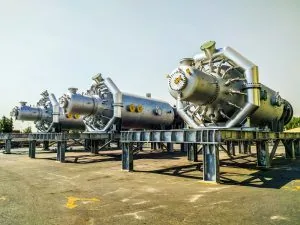
Composite autoclave technology serves a broad range of sectors. Each industry has specific requirements for part geometry, material systems, and quality standards, but they all share the same need: structurally reliable composite parts with repeatable quality.
The aerospace sector is the largest consumer of autoclave-cured composites. Fuselage panels, wing skins, engine nacelles, tail sections, and interior structural brackets all require autoclave processing to meet Federal Aviation Administration (FAA) and European Union Aviation Safety Agency (EASA) certification standards. An Aerospace autoclaves must produce parts with porosity levels below 1%, verified through ultrasonic inspection. The weight savings from carbon fiber composites directly translate to fuel efficiency and increased payload capacity for commercial and military aircraft.
Performance vehicles, Formula 1 race cars, and electric vehicle (EV) platforms increasingly use autoclave-cured carbon fiber components. Structural battery enclosures, body panels, crash structures, and suspension components benefit from the superior stiffness and weight reduction that autoclave curing provides. As EV manufacturers push for longer range through lighter vehicle weight, demand for composite curing autoclaves in the automotive sector continues to grow.
High-performance marine vessels, including racing yachts, naval patrol boats, and luxury superyacht structures, rely on autoclave-cured composites for hulls, decks, and structural bulkheads. Composite materials offer excellent corrosion resistance in saltwater environments, and autoclave curing ensures the laminates achieve full density with no moisture pathways that could lead to osmotic blistering over time.
Military applications demand composite parts that withstand extreme impact, blast loads, and environmental exposure. Ballistic armor panels, vehicle protection systems, radome structures, and unmanned aerial vehicle (UAV) airframes all rely on autoclave curing. The defense sector requires full material traceability, batch-level documentation, and compliance with military specifications (MIL-SPEC), making controlled autoclave processing essential.
High-end carbon fiber bicycles, racing helmets, tennis rackets, golf club shafts, and competitive rowing shells are manufactured using composite autoclaves. Autoclave curing produces lighter, stiffer parts compared to alternative methods, giving manufacturers a measurable performance advantage in weight-sensitive sporting applications.
Wind turbine blade root sections and spar caps are increasingly manufactured or repaired using autoclave-cured composites. The high fiber volume fraction and low void content achieved through autoclave processing improve fatigue life, a critical factor for blades that experience millions of load cycles over a 20-year service life.

0 – x psi

0 – x ºC

Electrical resistors / Thermal oil

Air / Nitrogen

Pressure relief valves, emergency stop

ASME Section VIII, PED compliant


x kg

High-performance thermal insulation
Selecting the right composite autoclave starts with understanding the technical parameters that affect part quality and production throughput. Here are the critical specifications procurement teams should evaluate.
Composite autoclaves typically operate between 45 psi and 150 psi (3 to 10 bar). Standard aerospace epoxy prepregs cure at around 85 to 100 psi, while high-temperature polyimide and bismaleimide systems may require higher pressures. Low-pressure systems (below 45 psi) are available for less demanding applications like fiberglass tooling or non-structural panels. TRG Supply designs systems across the full pressure spectrum to match your specific resin and material requirements.
Operating temperatures range from ambient up to 750°F (400°C), depending on the material being processed. Precise temperature uniformity across the entire working zone is essential. Industry standards typically require temperature variation of no more than ±5°F (±3°C) across all thermocouple locations during the cure hold. Our systems use multi-zone heating with PID controllers to achieve this level of accuracy.
Chamber dimensions vary widely based on the parts being produced. Diameters range from 3 feet (1 meter) for small component production up to 25+ feet (8+ meters), the size class covered by our large and walk-in autoclaves, built for full aircraft wing skins or fuselage barrel sections. Length can extend 60 feet (18+ meters) or more for oversized aerospace structures. TRG Supply builds each chamber to match the largest part in your production schedule, with room for efficient loading configurations.
Most composite curing autoclaves use forced-air convection heating powered by electric resistance heaters. This method provides excellent temperature uniformity and fast response to control system adjustments. For very large systems, thermal oil or steam-based heating may be more energy-efficient. The choice of heating method affects ramp rate, operating cost, and maintenance requirements.
Controlled cooling is as important as controlled heating. Our autoclaves incorporate internal heat exchangers, water-cooled coils, or chilled air circulation systems that allow operators to meet specified cool-down rates without overshooting. Faster cooling capability reduces total cycle time, which directly improves production throughput.
Modern composite autoclaves run on PLC-based control systems with touchscreen HMI interfaces. The controller manages temperature ramp rates, pressure profiles, vacuum levels, and alarm conditions automatically. Data logging captures every parameter of every cure cycle for quality records and traceability, a requirement for aerospace and defense customers. TRG Supply integrates industry-standard automation platforms that connect with your facility’s existing production management systems.
Our autoclaves for composites are designed to provide control over temperature, pressure, and vacuum throughout the curing process, ensuring that composite materials bond evenly and develop maximum strength.
With customizable cycle profiles, these autoclaves can accommodate a variety of materials and part sizes, from small prototypes to large production batches. Built for durability and consistent performance, proper composite curing in autoclaves helps in reducing defects caused by trapped air, resulting in high-quality, reliable composite parts and improved manufacturing efficiency.
Composite autoclave buyers in aerospace and defense require equipment that meets recognized safety and quality certifications. TRG Supply builds every system with compliance in mind from the earliest design phase.
All TRG Supply composite autoclaves are designed and fabricated in accordance with ASME Boiler and Pressure Vessel Code, Section VIII, Division 1. This certification is the industry standard for pressure vessel safety and is required by most facility insurance providers and regulatory bodies. Our ASME-certified pressure vessel construction includes third-party inspection, material traceability, hydrostatic testing, and code stamping.
Many aerospace manufacturers operate under Nadcap (National Aerospace and Defense Contractors Accreditation Program) accreditation for their composite processing operations. The autoclave itself must support Nadcap compliance by providing precise, repeatable cure cycles with full data logging. TRG Supply designs control systems that capture thermocouple data, pressure readings, and vacuum levels at intervals that satisfy Nadcap audit requirements.
Parts cured in our autoclaves must pass rigorous material validation testing, including destructive coupon testing, ultrasonic C-scan inspection, and glass transition temperature (Tg) verification. Our systems are designed to deliver the temperature uniformity and pressure consistency needed to produce qualification coupons that pass first-article inspection.
From raw steel plate certificates to final hydrostatic test reports, every component and process step is documented. Weld maps, non-destructive examination (NDE) records, calibration certificates, and material test reports are compiled into a comprehensive data book delivered with each autoclave. This documentation package supports your facility’s AS9100 quality management system and satisfies customer audit requirements.
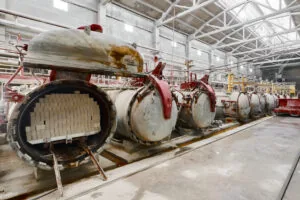
Every composite manufacturing operation is different. Part sizes, production volumes, material systems, and facility constraints all affect autoclave specifications. TRG Supply builds custom composite autoclaves tailored to your exact requirements, not modified off-the-shelf units.
We design chambers from compact 3-foot (1 m) diameter research units to massive, large-capacity systems exceeding 20 feet (6 m) in diameter and 60 feet (18 m) in length. Chamber geometry can be cylindrical or rectangular, with door configurations including full-opening swing doors, quick-opening breech-lock doors, or end-loading designs.
Operating envelopes are engineered to match your material portfolio. If you process standard 250°F epoxy prepregs today but plan to introduce 350°F bismaleimide materials in the future, we can design the vessel for the higher rating from the start, avoiding costly retrofits later.
Our control systems support programmable multi-step cure recipes, remote monitoring, and integration with plant-level SCADA or MES platforms. Operators can store hundreds of unique cure profiles and recall them instantly for different part numbers. Alarm management, password-protected access levels, and automatic data archiving are standard features.
Energy consumption is a high operating cost for composite autoclaves. TRG Supply offers high-performance thermal insulation packages, variable-frequency drive (VFD) fan motors, and heat recovery systems that reduce energy usage by 15% to 30% compared to older designs. These features pay for themselves through reduced utility bills over the life of the equipment.
We provide rail-mounted cart systems, rolling floor designs, and overhead crane-compatible loading fixtures. For high-throughput operations, dual-cart shuttle systems allow one cart to be loaded and prepared while another cart is inside the autoclave running a cure cycle, minimizing downtime between runs.
Aerospace customers often require additional features, including inert gas (nitrogen) pressurization to reduce fire risk, multiple vacuum port connections for complex tooling setups, pass-through thermocouple feedthroughs for part temperature monitoring, and redundant safety interlocks. TRG Supply has experience building systems that satisfy the requirements of Boeing, Airbus, and Tier 1 aerospace supplier specifications.
Ready to specify a composite autoclave for your facility? Contact TRG Supply to discuss your requirements with our engineering team. We provide detailed proposals with general arrangement drawings, control system specifications, and delivery timelines. Browse our full range of industrial autoclaves to explore other equipment categories.
A composite autoclave is a specialized machine that uses controlled heat and high pressure to cure composite materials like carbon fibre and resin. This process helps the materials harden and bond properly, creating parts that are both strong and lightweight.
The cure temperature depends on the resin system. Standard aerospace epoxy prepregs cure at 250°F (121°C) or 350°F (177°C). High-performance materials like polyimide and bismaleimide resins require temperatures up to 700°F (371°C). Temperature uniformity across the working zone must be maintained within ±5°F (±3°C), verified by multiple thermocouples placed on the part and inside the autoclave chamber. TRG Supply designs composite curing autoclaves with multi-zone heating and PID-based controllers to meet these tight tolerances.
Aerospace autoclaves are primarily used by commercial aviation manufacturers, military aircraft producers, and their supply chain of Tier 1 through Tier 3 suppliers. Beyond aerospace, the same autoclave technology serves the defense and ballistic armor industry, the automotive and EV sector (for structural carbon fiber components), marine and shipbuilding (corrosion-resistant hull structures), sporting goods manufacturers (bicycles, helmets, racing equipment), and the energy sector (wind turbine blade components). Any industry that needs composite parts with certified structural integrity will use this type of equipment.
The primary difference is pressure. A composite curing oven applies heat and relies only on vacuum bag pressure (approximately 14.7 psi at sea level) to consolidate the layup. A composite autoclave applies additional chamber pressure, typically 45 to 100+ psi, on top of the vacuum. This extra pressure dramatically reduces void content, increases fiber volume fraction, and produces parts with higher mechanical strength. Autoclave-cured parts consistently achieve porosity below 1%, while oven-cured parts often measure 2% to 5% porosity. For structural aerospace applications and any part where failure is not acceptable, autoclave curing is the required method.
The curing cycle length varies depending on the materials and part size, but usually lasts from 1 to 8 hours. Precise timing ensures that composites fully harden and achieve the desired strength without damaging the material.
Pricing varies based on chamber size, operating pressure and temperature, control system complexity, and any custom features. Small research-scale composite autoclaves may start in the range of $50,000 to $150,000, while full-size aerospace production autoclaves with advanced automation can cost several hundred thousand to over one million dollars. TRG Supply provides detailed quotations based on your specific requirements. Contact our team with your specifications for a tailored proposal.
Send your part dimensions, cure temperature and pressure profile, expected production volume, and any certification requirements such as ASME Section VIII or Nadcap-related documentation. TRG Supply uses these details to size the chamber, specify the heating and pressurization system, and scope an autoclave for composite curing that matches your process instead of a modified stock unit.
Contact us for more information on our products and how they can fulfill your manufacturing or sterilization needs. You may also ask us about our policies, ordering and delivery process, or for other related information.
Get In Touch